We Come Here to Remember ...
Outdoor Symbolic Memorial
The Outdoor Symbolic Memorial stands on the now-sacred ground where the events of April 19, 1995 unfolded. What was once the footprint of the Alfred P. Murrah Federal Building, Fifth street, the Athenian Building and Oklahoma Water Resources Board are now the Field of Empty Chairs, Reflecting Pool and Rescuer’s orchard.
Alfred P. Murrah Federal Building

One thing that remains from before the attack is the Survivor Tree, which stood in the parking lot across the street from the Federal Building, withstood the blast, and has become an icon of hope, strength and resilience. This Memorial honors those who were killed, those who survived and those changed forever on April 19, 1995.
Walking Tour
Discover More Significance
The Walking Tour book offers a deeper look at the meaning and symbolism of the Outdoor Symbolic Memorial.
Symbolic Elements
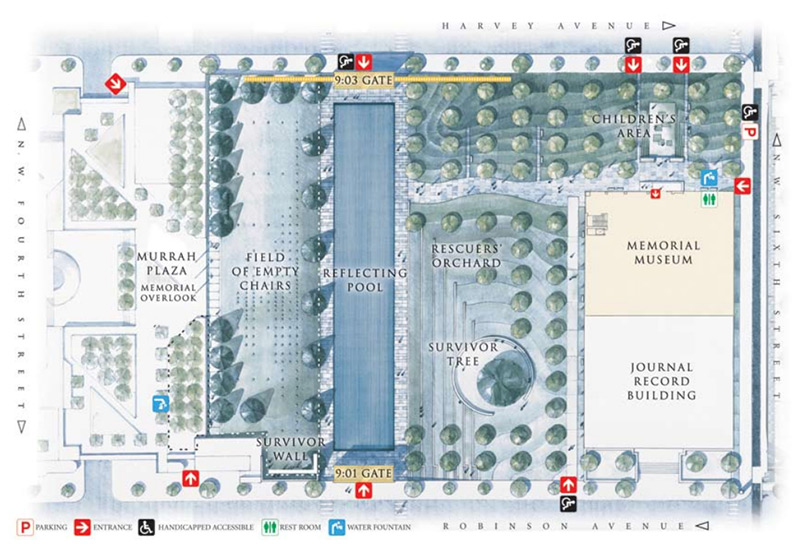
The following map shows the layout of the Outdoor Symbolic Memorial. Please note that north is to the right side of the map.
Gates of Time
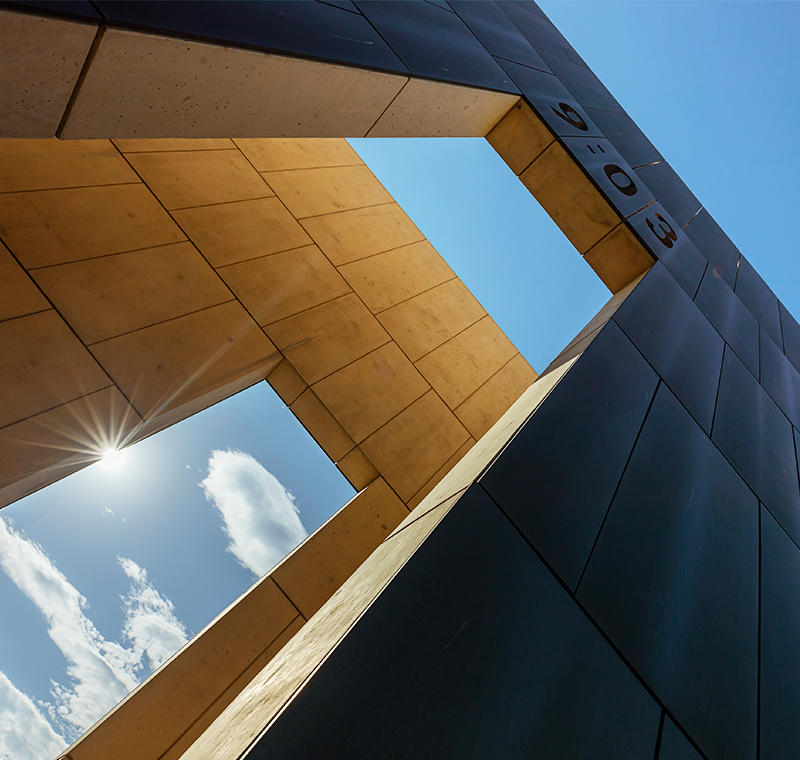
These monumental twin gates frame the moment of destruction – 9:02 a.m. – and mark the formal entrances to the Memorial. The 9:01 Gate represents the innocence before the attack. The 9:03 Gate symbolizes the moment healing began.
Reflecting Pool

The pool occupies what was once N.W. Fifth Street. Here, a shallow depth of gently flowing water helps soothe wounds, with calming sounds providing a peaceful setting for quiet thoughts. The placid surface creates the reflection of someone changed forever by their visit to the Memorial.
Field of Empty Chairs

The 168 Chairs represent the lives taken on April 19, 1995. They stand in nine rows, each representing a floor of the Alfred P. Murrah Building. Each chair bears the name of someone killed on that floor. Nineteen smaller chairs stand for the children. The field is located on the footprint of the Alfred P. Murrah Building.
Survivor Wall

On the east end of the Memorial stand the only remaining walls from the Alfred P. Murrah Federal Building. These walls remind us of those who survived the terrorist attack – many with serious injuries. Today, more than 600 names are inscribed on salvaged pieces of granite from the Murrah Building lobby.
The Survivor Tree

The Survivor Tree, an American elm, bore witness to the violence of April 19, 1995, and withstood the full force of the attack. Years later, it continues to stand as a living symbol of resilience. The circular promontory surrounding the tree offers a place for gathering and viewing the Memorial.
Get the Book
A touching tale of the Survivor Tree from its own perspective. Order yours today and discover a deeper level of meaning.
Rescuers’ Orchard

Like the people who rushed in to help, this army of nut- and flower-bearing trees surrounds and protects the Survivor Tree. An inscription encircling the Survivor Tree facing the orchard reads: To the courageous and caring who responded from near and far, we offer our eternal gratitude, as a thank you to the thousands of rescuers and volunteers who helped.
Children’s Area

In the aftermath of the blast, children from around the country and the world sent in their own expressions of encouragement and love. That care is immortalized today in a wall of tiles – each hand-painted by children and sent to Oklahoma City in 1995. In addition, buckets of chalk and chalkboards built into the ground of the Children’s Area give children a place where they can continue to share their feelings – an important component of the healing process.
The Fence

The first Fence was installed to protect the site of the Murrah Building. Almost immediately, people began to leave tokens of love and hope on the Fence. Tens of thousands of those items have been collected and preserved in our archives. Today, more than 200 feet of the original Fence gives people the opportunity to leave tokens of remembrance and hope.
About the Designers
Butzer Design Partnership was established in 1990 shortly after its partners, Hans and Torrey Butzer, graduated from The University of Texas at Austin. For a period of two years, they completed various residential projects and graphic commissions. In January of 1992, they relocated to Germany, where they spent 5 ½ years working with several architectural firms.
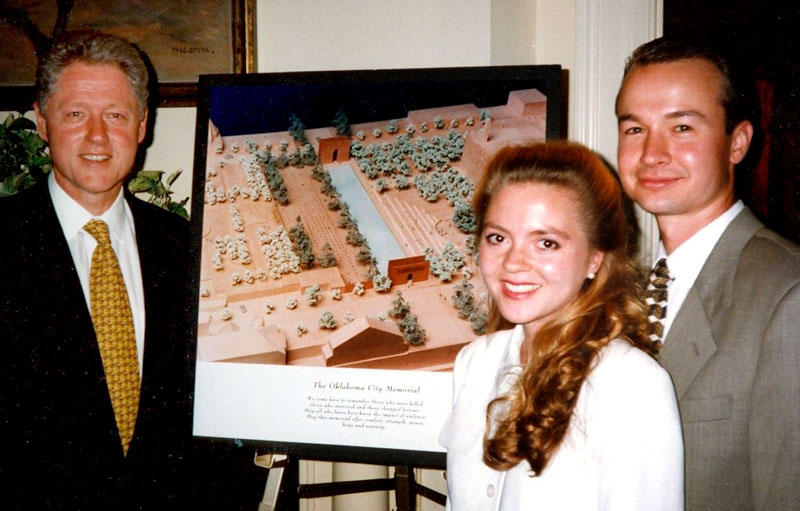
In early 1997, while living in Berlin, Germany, they participated in an international design competition for the Outdoor Symbolic Memorial component of the Oklahoma City National Memorial. Hans and Torrey’s associate Sven F. Berg assisted with the submission of their design. Their entry was selected as one of five finalists from a pool of 624 entries. As part of their final submission, Butzer Design Partnership submitted a list of team members that would act as consultants in the case that their entry be selected for construction. Included in that list were Sasaki Associates (Watertown, MA) and The Benham Group (Oklahoma City, OK).
The team, along with the other finalists, took their design to a 3-D model, proved their design could be built within budget and resubmitted their design to the Selection Committee, which consisted of 15 voting panelists and one nonvoting recorder. This panel included eight members of the families, survivors and rescuers, along with civic leaders and design professionals.
Following the selection of their design for the Oklahoma City National Memorial in July of 1997, Hans and Torrey Butzer relocated to Cambridge, Mass., where Hans began graduate studies at Harvard University’s Graduate School of Design. Throughout the phases of schematic design, design development, and construction documents, Butzer Design Partnership maintained artistic control of the design. As the design was developing, Hans and Torrey Butzer traveled to Oklahoma City to present it to the Oklahoma City National Memorial Foundation and the group of family members, survivors and rescuers.
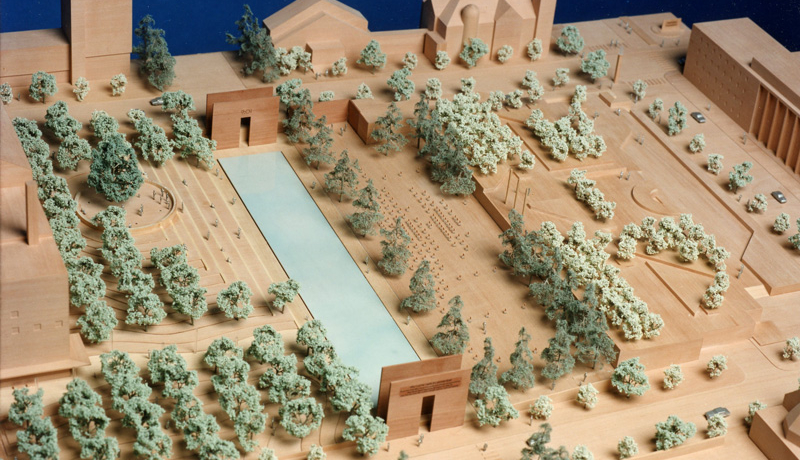
Groundbreaking on the Outdoor Symbolic Memorial was held in October 1998. In January of 1999, with construction just underway, Torrey relocated to Oklahoma City. Torrey was on-site almost daily, assisting the Memorial Foundation with the interpretation of the design during construction. In June of 1999, Hans received his Master of Architecture from Harvard University and promptly joined Torrey on-site.
Currently, the Butzers reside in Oklahoma City. Hans is dean of the College of Architecture at the University of Oklahoma.
The Oklahoma City National Memorial Outdoor Symbolic Memorial was dedicated on April 19, 2000, by U.S. President Bill Clinton.